Projects

Detailed case studies with context, decisions, and outcomes

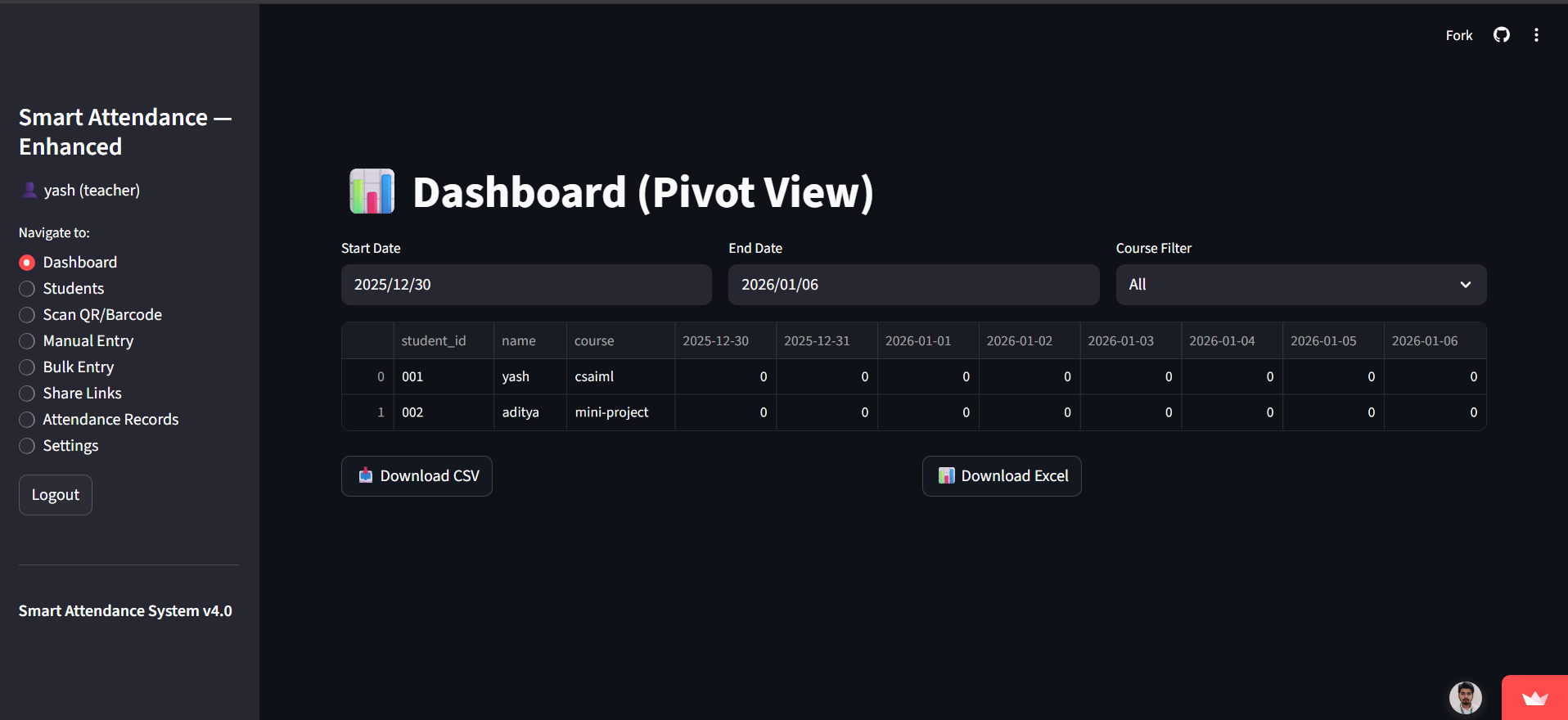
Smart Attendance System

2025

Open Source

Smart Attendance System

Context

Manual attendance is time-consuming, error-prone, and allows proxy entries. An automated system using QR codes, barcodes, and manual fallback improves accuracy and saves class time.

Constraints

Limited hardware, low budget, internet dependency for QR scans, basic security (no biometrics), and restricted scope without full LMS features.

Decisions

Used QR/barcode for low-cost automation, Python + Streamlit for fast development, MongoDB for flexible storage, and added basic analytics instead of just data storage.

Outcome

Free to use and alter it

Reflection

The system works well for automation and insights but cannot fully prevent proxy attendance. It is a practical academic prototype, not a production-grade solution.

PythonStreamlitQR & BarcodeMongoDB

Car Price Prediction ML

2025

Open Source

Car Price Prediction ML

Context

Used car pricing is inconsistent and subjective. Buyers and sellers lack data-backed valuation. This project builds an end-to-end ML pipeline to predict used car prices using historical data and modern regression models.

Constraints

Data quality issues (missing values, outliers), limited feature reliability from public datasets, model interpretability vs accuracy trade-off, and the need to keep the system lightweight and reproducible.

Decisions

Used a modular ML pipeline with preprocessing, feature engineering, and model training separated. Chose ensemble models (Random Forest, XGBoost) for accuracy, with Linear Regression as a baseline. Added evaluation metrics, logging, and testing to make it production-ready.

Outcome

Free to use and alter it its Open socurce

Reflection

The system achieves strong predictive performance and clean architecture, but accuracy depends heavily on dataset quality. Real-world deployment would require continuous retraining and region-specific data to avoid pricing bias.

Pythonscikit-learnStreamlitPandasNumpy

CNN Pneumonia Detection – Hugging Face Fine-Tuning

2025

Fine-Tuning Pretrained Models

CNN Pneumonia Detection – Hugging Face Fine-Tuning

Context

Pneumonia diagnosis from chest X-ray images is time-critical and error-prone due to radiologist workload and visual similarity between conditions. This project fine-tunes a pre-trained CNN model from Hugging Face to classify pneumonia vs normal cases using medical imaging data.

Constraints

Limited labeled medical datasets, class imbalance, high risk of overfitting, strict need for high recall, and ethical constraints preventing use as a standalone diagnostic tool.

Decisions

Used transfer learning with a pre-trained CNN (e.g. ResNet/DenseNet) to reduce data requirements. Applied data augmentation, weighted loss for imbalance, and fine-tuned upper layers only to preserve learned visual features. Evaluated using recall, precision, and AUC instead of accuracy alone.

Outcome

None

Reflection

The model performs well for assisted screening but is not clinically deployable without validation across hospitals and devices. Real-world use would require regulatory approval, explainability, and continuous retraining on diverse datasets.

PythonHugging FacePyTorchMedical Imaging

Multiagent Corp – Multi-Agent Corporate System

2025

Agent-Based Orchestration

Multiagent Corp – Multi-Agent Corporate System

Context

Modern software development is fragmented across planning, coding, testing, and documentation. This project models a virtual corporate organization of AI agents to automate end-to-end software development workflows with clear role separation and accountability.

Constraints

High coordination overhead between agents, dependency on external APIs (LLMs, Supabase), latency from multi-step orchestration, and limited real-world guarantees without human-in-the-loop validation.

Decisions

Designed role-specialized agents (CEO, PM, Research, Coder, QA, Docs) to mirror real corporate workflows. Used centralized orchestration, shared context storage (Supabase), and strict role boundaries to reduce hallucination and task overlap.

Outcome

Free to use and alter it its Open socurce

Reflection

The system demonstrates strong workflow automation and clarity of responsibility but is only as good as its orchestration logic. Without governance rules and failure handling, multi-agent setups risk becoming slow, noisy, or redundant rather than efficient.

PythonOpenrouterFlaskSupabase